Hiding in plain sight: a new cat from the cloud forest and a new penguin from the Desolation Islands
A small wild cat from Bolivia and a penguin from the Southern Ocean are the first new species of their families to be named for more than a century. Both animals had been seen many times before anyone recognised them as distinct. Some years ago a man in Bolivia found a kitten on a road […]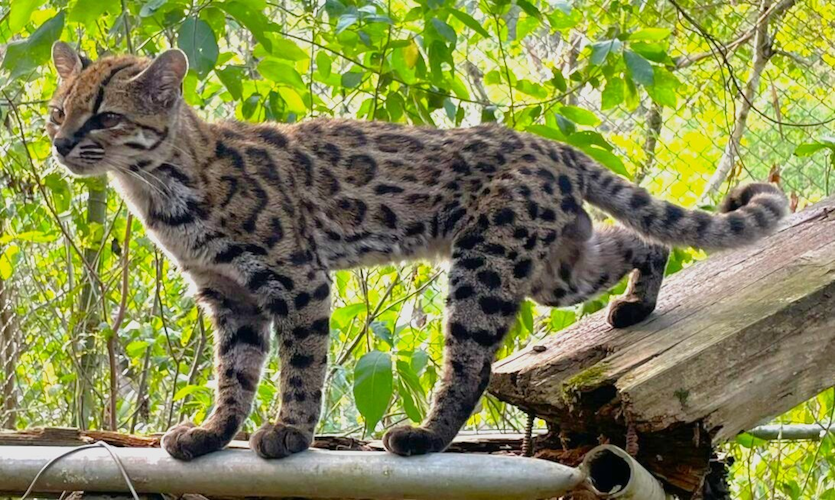
A small wild cat from Bolivia and a penguin from the Southern Ocean are the first new species of their families to be named for more than a century. Both animals had been seen many times before anyone recognised them as distinct.
Some years ago a man in Bolivia found a kitten on a road near a forest and raised it at home as a domestic cat. After about a year he realised it was wild, and it went to the Senda Verde animal refuge in the Yungas, the cloud forests on the eastern slopes of the Andes. In 2017 the refuge asked the biologist Paola Nogales-Ascarrunz to look at it. She took it for a tiger cat, then thought to be a single species ranging across much of Central and South America. Two years later, while preparing a booklet on Bolivia’s wild cats, she noticed that its rosettes were much larger than those in reference photographs from Brazil.
She and her colleagues have since sequenced the genomes of 38 cats from the genus Leopardus, eight of them from museum specimens. Their paper, published in Current Biology in September, shows that tiger cats comprise five species, and that the Bolivian lineage separated from its relatives about 1.4 million years ago. They have named it Leopardus tilcayo, keeping the name used by local people. Nobody could say what tilcayo means, and it does not appear to derive from Spanish or Quechua. The last living cat species to be described before it was the Uruguayan pampas cat, in 1923.
Gentoo penguins look much the same throughout their range, from the Falkland Islands to the sub-Antarctic islands of the Indian Ocean, and how to classify them has been debated since the 1920s. A team based in Chile and at the University of California, Berkeley sequenced the genomes of 64 gentoos from ten colonies covering nearly the whole range. Their paper, published in Communications Biology in April, describes four lineages descended from a common ancestor that lived about 800,000 years ago, kept apart by the distances between islands and by the Antarctic Polar Front. The authors propose treating each lineage as a species.
Three of the four already had names. The fourth, the southeastern gentoo Pygoscelis kerguelensis, breeds on the Kerguelen Islands in the southern Indian Ocean and probably also uses nearby Heard Island. Its plumage is identical to that of other gentoos. It differs mainly in body size, and its genome carries signs of selection on genes associated with vocal learning. The specimen chosen to define the species is a skin collected on Kerguelen on 31 December 1897, held ever since at the American Museum of Natural History. It is the first penguin species to be named since 1921.
Recognition has practical consequences, because conservation status is assessed species by species. When a widespread species turns out to be several, each is smaller, and may be more vulnerable, than the aggregate suggested. Little is known about the tilcayo in the wild. It has been confirmed only in the Bolivian Yungas, its numbers are unknown, and the Yungas are losing forest to farming and new roads, and in the north of La Paz department to gold mining.
The IUCN lists the gentoo as a single species of Least Concern. The authors point out that this status reflects mainly the southern gentoo of the Antarctic, which accounts for about 65 per cent of all gentoos. The other three are less secure. On Macquarie Island, in the eastern gentoo’s range, breeding pairs have halved over three generations, and the most recent census of Kerguelen dates from 1985. Under a moderate warming scenario, the authors’ habitat models suggest that by 2050 the northern, eastern and southeastern gentoos could lose suitable conditions across much of their current range, while suitable habitat for the southern gentoo expands by about 9 per cent. They caution that the models describe habitat suitability and should not be read as forecasts of extinction, and they ask for each species to be assessed separately.
Both animals were hiding in plain sight, taken for familiar species until someone looked more closely. Much of the distinctness of life is still waiting to be noticed, even among animals we believe we already know.
Standing beside: No member yet stands beside the tilcayo or the southeastern gentoo. Either could be chosen on the platform today.
Sources: National Geographic; PBS NewsHour / AP; UC Berkeley release via EurekAlert; Science News
Papers: Lescroart, J., Nogales-Ascarrunz, P. et al. (2026) Phylogenomics and museomics reveal five distinct species of tiger cats in South America. Current Biology 36(19): 5027–5041.e8. doi:10.1016/j.cub.2026.08.059. Noll, D. et al. (2026) Integrative evidence reveals adaptive divergence and speciation in gentoo penguins. Communications Biology 9: 798. doi:10.1038/s42003-026-10081-7.
Photo: “Leopardus tilcayo” by Paola Nogales Ascarrunz, via Wikimedia Commons, licensed under CC BY-SA 4.0. (Note: Cropped and colour-adjusted from the original).