Who stands beside whom? What our early adopters tell us
We read every early adopter profile to see which beings people have chosen, and why. Here is what we found. Who stands beside whom? What our early adopters tell us We read every early adopter profile to see which beings people have chosen, and why. Here is what we found. Since I Stand Beside opened, […]
We read every early adopter profile to see which beings people have chosen, and why. Here is what we found.
Who stands beside whom? What our early adopters tell us
We read every early adopter profile to see which beings people have chosen, and why. Here is what we found.
Since I Stand Beside opened, people have been joining as early adopters, choosing a being to stand beside and telling us why. In November we read every public profile to see who has joined, which beings they have chosen, and what they say about the relationship.
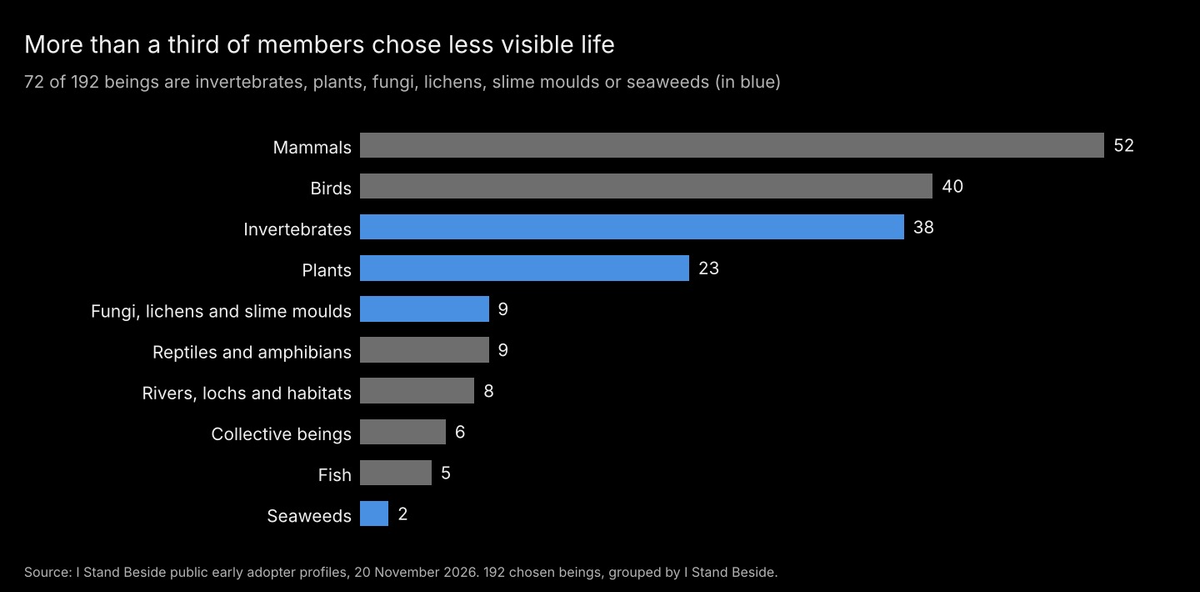
The beings. Mammals and birds are the most popular choices, and the otter and the hedgehog the most popular single beings. Yet more than a third of members chose less visible life. Some chose a being precisely because it is overlooked: slime moulds, a mycorrhizal fungus, lichens, a liverwort, tardigrades, earthworms, maerl, the medicinal leech, a pond mud snail. Others stand beside threatened species in active recovery, among them the wildcat, the capercaillie, the great yellow bumblebee and the pine hoverfly. Some chose a place or a whole: the Thames, the Wye, Loch Ness, a Highland burn, the Web of Life, the Unknown Beings. Around one in five beings live beyond the UK, from the Cross River gorilla to Blakiston’s fish owl. Fish are still scarce, and no one yet stands beside a coral.
The people. Most of those who say where they live are in Scotland, especially around Banchory, Inverness and the Highlands, and Argyll. This reflects the reach of Jane Frere’s exhibition The Ark – We Stand Beside at the Barn in Banchory. Many others live in England, and members have joined from as far as Venezuela, Palestine, Japan, Indonesia, Tasmania and the Bahamas. They include conservation scientists and practitioners, artists, writers, musicians, broadcasters and whole families, with children as young as four.
The reasons. Members give five kinds of reason for their choice:
- A meeting or a place: house martins under the eaves, a burn walked every day.
- Decline, often described with figures, and a wish to help reverse it.
- Being overlooked, so that someone should notice.
- What the being teaches, such as the wood ant’s collective life or the long time of an oak.
- Family and memory, such as red squirrels a relative cared for over five decades.
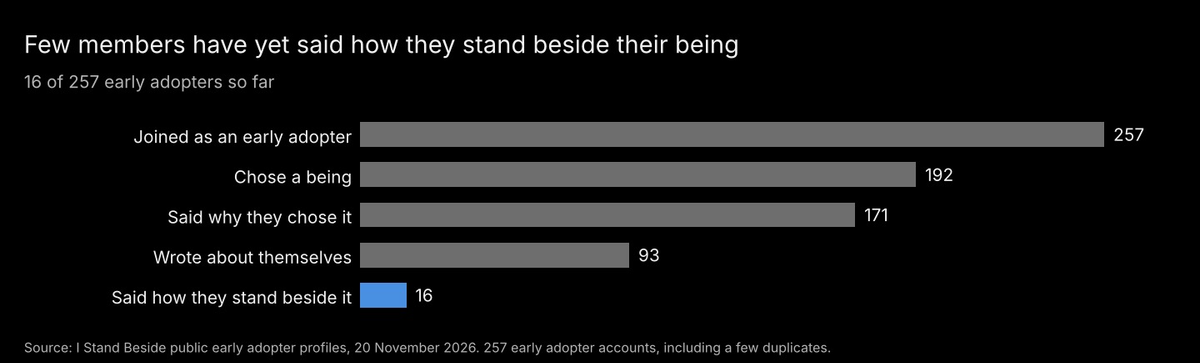
What comes next. Far fewer people have said how they stand beside their being than why they chose it: only 16 so far. Where they have, the answers are varied and practical. They include restoring a burn, planting acorns, breeding animals for release, campaigning for the Thames, the Wye and swift bricks, writing poetry and recording an album about wasps.
Standing beside: If you are a member, please add a line to your profile about how you stand beside your being, so that others can learn from it. And if no one yet stands beside a coral, or beside many of the fish of our rivers and seas, perhaps that is an invitation.