Jeremy LentSlime Moulds

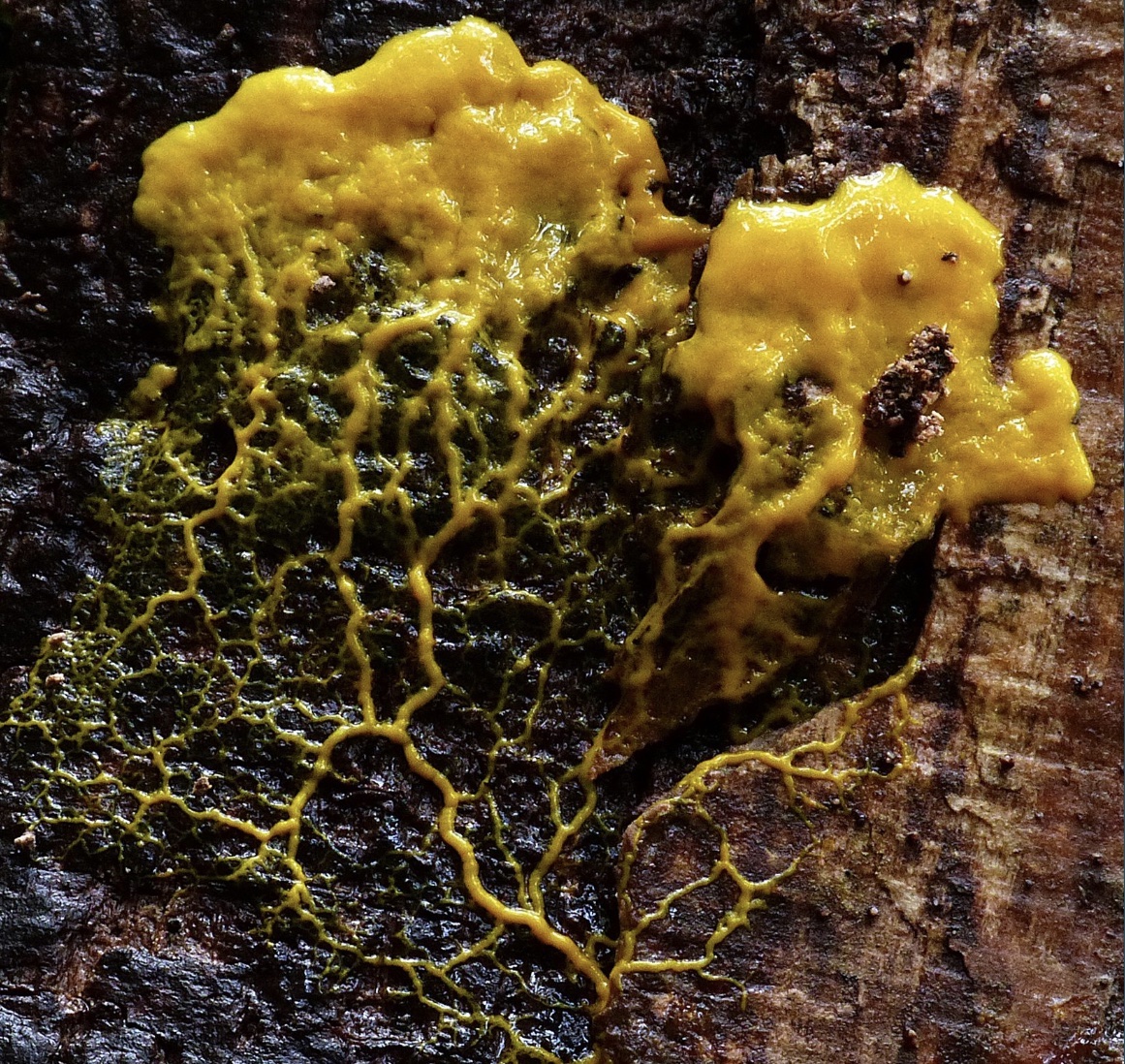
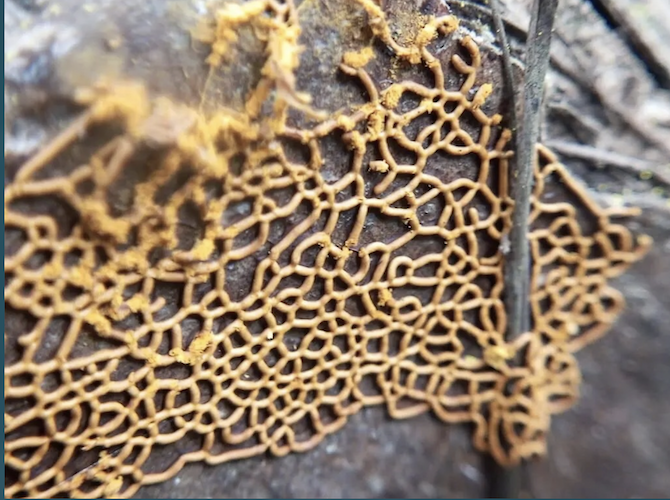
If you’ve ever hiked in a forest, and came across a yellow gooey mass growing in a shady, damp spot, you were probably looking at a slime mold. They can occupy an area as large as a square meter. At a certain phase in their life cycle, they grow a network of tube-like structures called pseudopodia, which they use to crawl around, looking for food. When there are multiple food sources, they will adapt their shape to access each of the sources in the most efficient way possible—and this is where their virtuosity takes center stage.
Scientists have sliced up a slime mold and scattered it in a maze with food at the beginning and end. The slime mold responds by filling the space, and after discovering the food, literally solves the maze by shrinking itself to occupy only the shortest possible route between the food sources. Amazingly, scientists have discovered that slime molds can perform efficient network design. They have scattered oatmeal in a Petri dish to represent real-world cities, and the slime mold has linked them in ways that are frequently more efficient than existing road and rail routes. Researchers have used slime molds to determine the relative efficiency of different highway networks, discovering for example that Canada and China were more efficient than the U.S.A. and Africa. Slime molds have even shown the ability to learn from experience, recognizing the frequency with which they’re given shocks, and preparing themselves in anticipation of the next one.
I am an author and speaker whose work investigates the underlying causes of our civilization’s existential crisis, and explores pathways toward a life-affirming future. I am author of The Patterning Instinct: A Cultural History of Humanity’s Search for Meaning and The Web of Meaning: Integrating Science and Traditional Wisdom to Find Our Place in the Universe. I am also the founder of the Deep Transformation Network, a global community exploring pathways toward a life-affirming future on a regenerated Earth. I have written extensively about the vision and specifics of an ecological civilization, am a founding member of the Ecocivilization Coalition, and am president of its parent, the Institute for Ecological Civilization.
My upcoming book, Ecocivilization: Making a World that Works for All, will be published by Melville House in May 2026.
Photos: Bernard Spragg