Corals that recover through touch
Corals are animals, and most reef-building corals live in partnership with microscopic algae that live inside their tissues. The algae feed the coral with sugars made from sunlight, and give it its colour. When seawater stays too warm for too long, the partnership breaks down. The coral expels its algae, turns white and begins to […]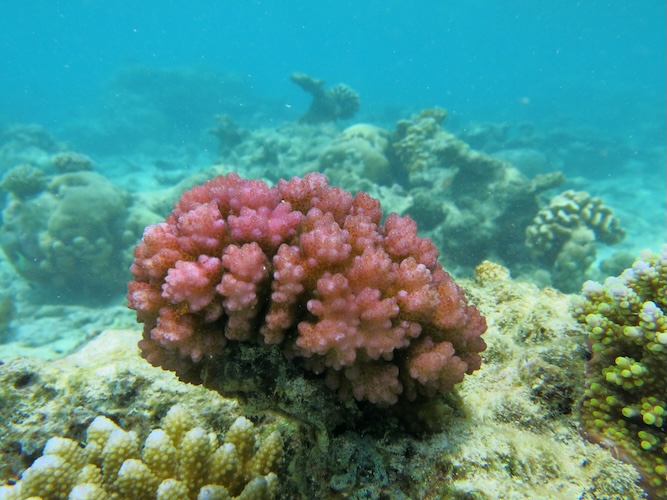
Corals are animals, and most reef-building corals live in partnership with microscopic algae that live inside their tissues. The algae feed the coral with sugars made from sunlight, and give it its colour. When seawater stays too warm for too long, the partnership breaks down. The coral expels its algae, turns white and begins to starve. This is bleaching. Corals that survive can take months or years to recover.
The study began with an accident. According to the researchers, in 2025 a healthy fragment of coral in a laboratory tank at Stanford tipped over and came to rest against a bleached fragment from the same colony. The marine scientist Steve Palumbi noticed that, where the two touched, the bleached coral was regaining its colour.
Danny Collins, a PhD student in Palumbi’s group, set out to test this, and the results were published in Science Advances on 14 October 2026. He bleached small fragments of the coral Pocillopora damicornis by heating their tank to about 34.5°C, then placed each one against a healthy fragment from the same genetic individual. A few algae crossed into the bleached tissue within hours. Within two to three days the fragments had formed bridges of living tissue where they touched, and algae began to move across in large numbers. A week of contact was enough: every fragment touched for that long went on to recover fully after it was separated, within seven weeks. Fragments left in contact throughout recovered within eight weeks. Once established, the algae doubled roughly every four days, far faster than in bleached corals studied elsewhere. None of the five bleached fragments kept a few millimetres from a healthy partner recovered. By nine weeks most were smothered by algae, and two had died.
The limits are real. The experiment used one species, two genetic individuals and small aquarium-raised fragments whose wild origin is unknown. Recovery happened only between pieces of the same genetic individual. When the researchers paired corals of different genotypes, the corals behaved antagonistically, none of the bleached fragments recovered, and in most pairs the healthy coral grew over the bleached one. On a reef, a bleached coral would therefore need healthy tissue of its own, and nobody yet knows over how large an area contact can restore a colony. The authors say the method still has to be tested in other species and in the field. Terry Hughes, a reef scientist who was not an author of the study, made the wider point in coverage of it: the best way to help corals survive and recover is still to cut greenhouse gas emissions.
The study also shows how much a bleached coral retains. As Collins put it, bleached corals may be dying, but they are not dead yet. The authors suggest that, if the method can be scaled, it might one day be used to pass naturally heat-tolerant algae to corals recovering from bleaching.
Standing beside: No member yet stands beside a coral, although one stands beside the sea nettle, a jellyfish and a distant cousin of the corals. Would you be the first to choose a coral?
Sources: Stanford Report; Smithsonian; Euronews
Paper: Collins, D. S. et al. (2026) Rapid coral bleaching recovery via symbiont transfer from healthy corals. Science Advances 12(42): eaeh1580. doi:10.1126/sciadv.aeh1580
Press sources for the origin story and quotes: Stanford Daily (the 2025 observation); Euronews (Collins); Honolulu Star-Advertiser, reprinting the New York Times (Hughes).
Photo: “Pocillopora damicornis Landaagiraavaru” by Ahmed Abdul Rahman, via Wikimedia Commons, licensed under CC BY-SA 4.0.