Rights of Nature at COP30
Rights of Nature did not shape the COP30 negotiating texts. It did not feature prominently in the Action Agenda. It remained largely outside the formal UNFCCC space in Belém. Yet across the two weeks, it was present in a consistent and increasingly coordinated way. We encountered it in Indigenous councils, youth gatherings, civil society forums, […]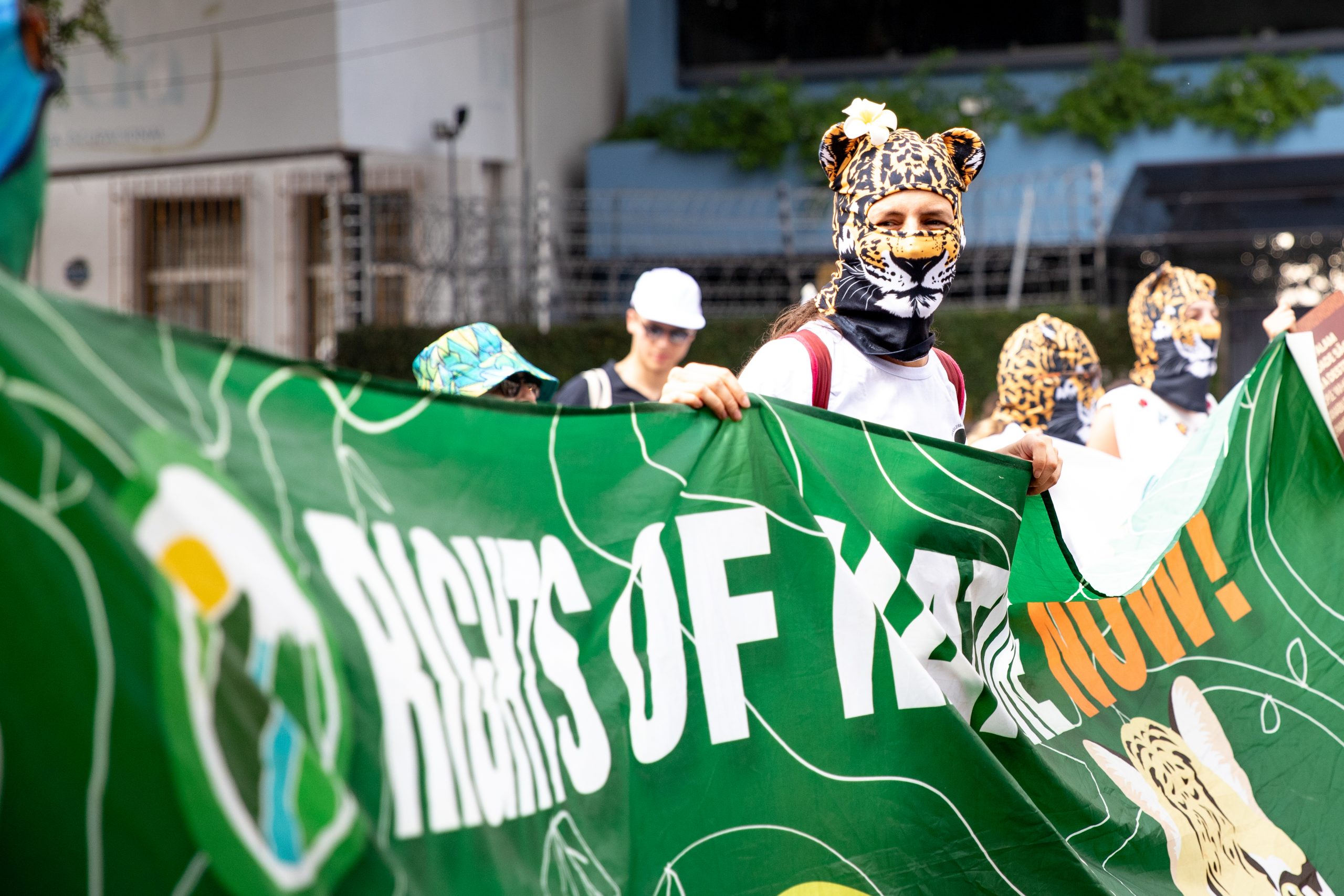
Rights of Nature did not shape the COP30 negotiating texts. It did not feature prominently in the Action Agenda. It remained largely outside the formal UNFCCC space in Belém. Yet across the two weeks, it was present in a consistent and increasingly coordinated way. We encountered it in Indigenous councils, youth gatherings, civil society forums, the People’s COP, and the streets of the city itself. It was closely linked to debates on Just Transition, governance, and limits. That presence matters, because it points to a gap that climate processes continue to struggle to address: how to set enforceable boundaries that prevent ecological harm, rather than relying primarily on mechanisms that manage, price, or offset damage.
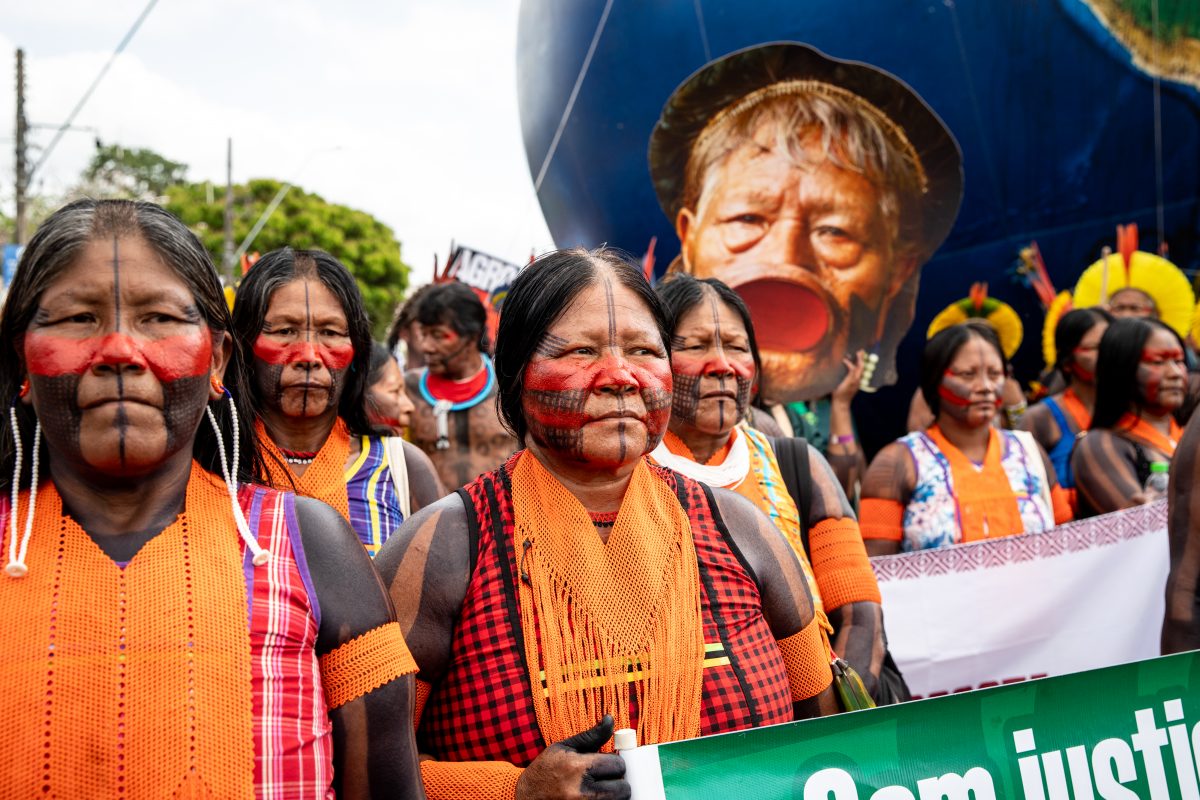
We joined a wide range of events during the conference, including the Global Alliance for the Rights of Nature (GARN) Indigenous Council, the “We Are Nature” dialogues, youth-led sessions at the GARN Youth Hub, the Mother Nature Pledge, and the launch of WECAN’s policy brief on Rights of Nature as a Central Pillar of a Just Transition. Across these spaces, several themes surfaced repeatedly, expressed with clarity and urgency.
The Indigenous Council opened in ceremony.
One elder said, “We are always in ceremony. This is how we communicate with one another; this is how we stay in touch with the living world.”
From the outset, the framing was clear. Rights of Nature was described as a partial legal translation of Indigenous legal orders that have long governed relationships between people, land, water, and other beings. Several speakers emphasised that this translation is incomplete and carries risks. Once Rights of Nature language enters state policy and international negotiations, it can be detached from Indigenous governance systems and used to legitimise projects that still rely on dispossession or technocratic control.
“When the river is polluted, when the land is destroyed, then who are we?” they asked.
Speakers returned often to implementation. A representative from Canada reflected on the long struggle for legal recognition of Indigenous rights and the difficulty of translating those gains into practice, saying, “Getting recognition is one thing. The problem is local implementation. We need to support one another and put pressure on those who are supposed to uphold the laws.” Another speaker reminded the room that rights only exist when they are exercised, through ceremony, language, harvesting, monitoring, and, when required, direct action on the land.
Several leaders spoke directly about cosmology and law. One Dine speaker explained that in their language and worldview, identity flows from the Earth itself.
Another voice described colonial systems as operating from a fundamentally different orientation to land and responsibility, raising the challenge of finding shared ground without erasing Indigenous ways of knowing.
These concerns reappeared later in the week at the launch of WECAN’s policy brief. Osprey Orielle Lake posed a direct question to the room: “Where are our rights in these negotiations?” She noted that rights are rarely discussed in climate negotiations because they are not easily commodified or traded. The brief argues that a Just Transition requires more than technological substitution or workforce planning. It calls for structural change in economic, legal, and governance systems, with Rights of Nature positioned as a framework that can raise thresholds for harm, guide finance away from extractive pathways, and strengthen legal standing and guardianship for ecosystems.
Several speakers contrasted Rights of Nature with existing environmental regulation. One said, “We don’t have fragile ecosystems. We have fragile minds.” Another stated plainly, “Nature doesn’t allow thresholds of pollution.” These comments captured a recurring critique: regulatory systems often normalise harm by defining acceptable levels of damage, while Rights of Nature frameworks begin from duties to protect ecological integrity.
There was also a strong legal undercurrent throughout the week. While Rights of Nature is not embedded in the UNFCCC, recent court decisions are reshaping the context in which climate policy operates. The Inter-American Court of Human Rights’ Advisory Opinion OC-32/25 affirmed that states have obligations to prevent environmental harm as part of their human rights duties, including within a climate emergency. The International Court of Justice’s July 2025 advisory opinion further confirmed that states have binding obligations under international law in relation to climate change, with potential legal consequences for inadequate action. Participants repeatedly noted that these rulings strengthen the case for rights-based and nature-centred approaches, even where formal climate processes lag behind.
In movement spaces, Rights of Nature was frequently described as one of the fastest-growing environmental movements. While the scale and enforceability of initiatives vary widely, mapping studies have documented hundreds of Rights of Nature laws, ordinances, and legal cases across dozens of countries. Indigenous speakers cautioned against treating growth as success in itself, returning again to the question of governance and who holds authority in implementation.
Ecuador became a political reference point during the conference. While COP30 was underway, voters rejected proposals widely seen as opening the door to weakening the country’s 2008 constitutional recognition of the Rights of Nature. The result does not resolve Ecuador’s ongoing conflicts over extraction and enforcement. It does, however, indicate durable public support for ecological constitutionalism and reinforced the sense that Rights of Nature can carry political legitimacy beyond activist spaces.
Youth leadership added another dimension to these discussions. At the GARN Youth Hub’s Extreme Hangout, we heard from a group of young women whose contributions combined legal insight with strategic clarity. Emily Zinkula described Rights of Nature as a way of expanding legal imagination, noting that many existing legal tools can already support nature-centred governance if they are applied differently. Tosana Maria Töben spoke about the need to make the movement accessible and inclusive, emphasising the importance of supporting youth leadership through local institutions. Roberta Bosu highlighted how language itself shapes relationships with the living world, pointing out that English often encourages distancing by referring to living beings as “it.” Quetza Ramirez framed Rights of Nature as “a movement for the liberation of all beings on Earth,” a statement that resonated across generations in the room.
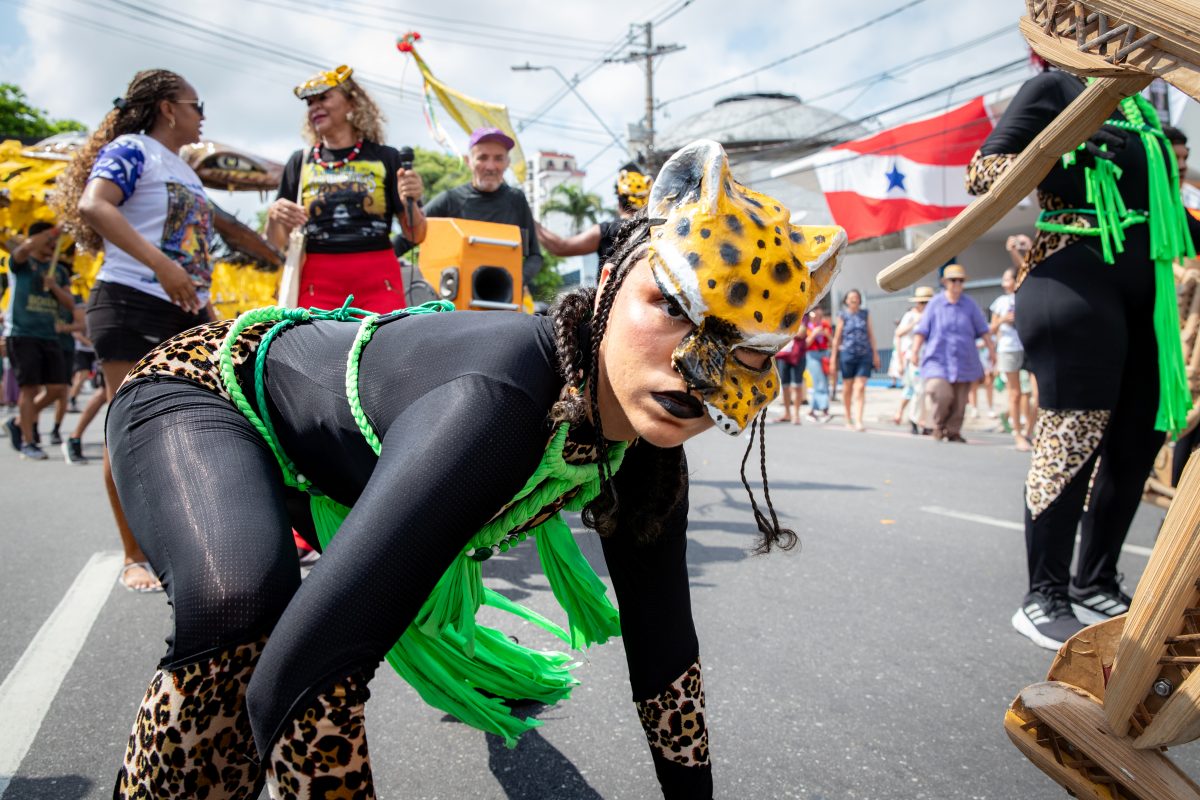
Outside the formal venues, the People’s March brought these governance questions into the open. Tens of thousands walked through Belém—Indigenous peoples, quilombola communities, riverine groups, youth, scientists, and organisers—carrying banners, songs, and art. One of the clearest symbols was a 30-metre forest serpent made by the People’s Climate Alliance of Brazil.
In many Amazonian traditions, the snake is sacred: a guardian of forest and waters. This serpent carried that meaning, and also a direct message about money and justice. Its origin story began weeks earlier on the Xingu River, during a gathering on Capoto Jarina Indigenous Land. The shaman Kamirrã dreamed of a snake rising from the river and moving through the sleeping huts, calling peoples to unite in defence of their territories. Organisers worked with artists from Alter do Chão, including Relison Sousa and a team of sixteen, to build the snake and then transport it to Belém by boat—a two-day journey upriver.

The wordplay was intentional. In Portuguese, cobra means snake, and cobrar means to charge or collect what is owed. The serpent turned a complex demand into a clear one: climate finance should reach the people protecting the forest, directly and at scale. As Helena Ramos of Amazônia da Pé, a grassroots group involved in building the snake, put it: “We came here with the message that we need climate finance for the people living in the Amazon.”
Across the week, we heard the same grounding phrase: “We are nature protecting itself.” It captured the gap Rights of Nature is trying to close. Climate policy can move capital and deploy technology without drawing firm lines around what harms are unacceptable, and without giving living systems standing when they are harmed. Rights of Nature pushes decision-making toward duties, limits, and accountability. It brings biodiversity, land, and ecosystems into the centre of climate justice—exactly where they belong.
Learn more
WECAN – Rights of Nature as a Central Pillar of a Just Transition
https://www.wecaninternational.org/just-transition
WECAN – COP30 press release on the policy brief
International Rights of Nature Tribunal – A New Pledge for Mother Nature
Inter-American Court of Human Rights – Advisory Opinion OC-32/25 (PDF)
https://www.corteidh.or.cr/docs/opiniones/seriea_32_en.pdf
International Court of Justice – Obligations of States in respect of Climate Change (case page)
https://www.icj-cij.org/case/187
International Court of Justice – Advisory Opinion of 23 July 2025 (PDF)
Putzer et al. (2022) – “Putting the rights of nature on the map…”
https://www.tandfonline.com/doi/full/10.1080/17445647.2022.2079432
Epstein et al. (2023) “Science and the Rights of Nature”
https://www.science.org/doi/10.1126/science.adf4155
GARN – Rights of Nature at COP30 (overview page)
Ecuador referendum reporting – Inside Climate News
People’s March coverage – The Guardian (15 Nov 2025)