The Ark – We Stand Beside
The first We Stand Beside event created by I Stand Beside co-founder Jane Frere There’s ‘Art for Art’s sake’ and there’s art that aspires to be a vehicle for positive change. In this fraught age of polycrisis, elbowing our way through the din and furore of multiple burning issues, never have we artists been so […]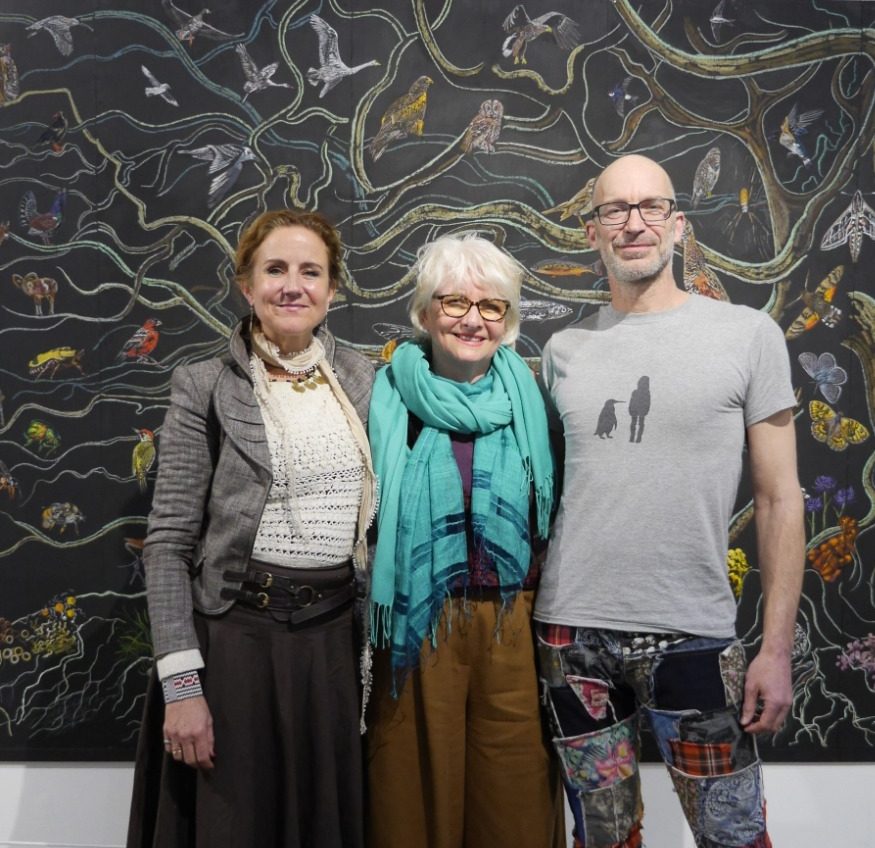
The first We Stand Beside event created by I Stand Beside co-founder Jane Frere
There’s ‘Art for Art’s sake’ and there’s art that aspires to be a vehicle for positive change. In this fraught age of polycrisis, elbowing our way through the din and furore of multiple burning issues, never have we artists been so challenged.
As both artist and curator, I devised the exhibition which ran 26 March – 19 April,especially to expand the beautiful and profound concept of I Stand Beside by taking it into a non digital arena. This had to be a show with a difference.
The Barn is a thriving arts complex in the rural town of Banchory, not far from Aberdeen. Its own credo is to raise ‘awareness, feelings and forms of action around the environmental crisis, connecting growers, activists and inhabitants with artists and scientists’. Thanks to the generous support of sponsors Fiona and Mark Hope, two of the original founders of The Barn, it presented the perfect opportunity to share and expand the I Stand Beside movement in its first year.
My collaboration with The Barn took a holistic approach to what became virtually a mini-festival around the exhibition itself with panel talks, nature and art workshops, and related film screenings culminating in a finale of a live concert by Salt House Band, featuring Aberdonian singer songwriter Dr Jenny Sturgeon, a seabird ecologist now based in Shetland.
We aimed to create a celebration of people, art and nature encouraging reflection, discussion and debate for children and adults alike as we face the most profound tragedy in human history – the breakdown of the natural world.
Launched with a formal opening by ISB founders Prof Nathalie Seddon, John Paul Frazer and myself, Nathalie delivered a presentation drawing on her collaboration with other experts for the National Emergency Briefing perfectly fitting the exhibition’s dual mission to celebrate the beauty, awe and wonder of earth’s biodiversity while confronting the looming threat of extinction.
Merging my earlier work on the Ark Project with I Stand Beside in an exploration of biodiversity declining towards extinction, I wanted to ensure we adhered to the fundamental ethos at the core of ISB – love, care and compassion for the ‘overlooked and forgotten beings’ and the ‘voiceless heroes of our earth’
As the ISB’s embryonic web platform began to fill with Human and more than Human Beings and their images and stories, so did the entwining branches of my huge pastel Tree of Life fill with a random combination of 168 magnificent species nominated by over 170 people. The mural grew to five metres wide..
The naturalist Chris Packham and Scottish film actor Brian Cox were the first of the celebrity “pied pipers” adding their names to the taxonomic species list with the rare The Bog Sun Jumper spider and Eurasian wolf
In their colourful hues and patterns I purposely exaggerated the size of the tiny unsung heroes, the insects and invertebrates, essential elements of healthy eco-systems, alongside birds and fish rendered larger by comparison to the well championed cute and cuddly mammals.
This resonated well with Buglife, a charity dedicated to the preservation of all invertebrates which chose four exciting endemic species from each country across the UK – Northern February Red Stonefly, Lundy Cabbage Flea Beetle , Celtic Woodlouse, and Irish Damselfly
Curating guest artists whose work has already warmed to the ecological theme resulted a welcome addition to their number. Novelist Max Porter was introduced by one of Britain’s leading wood engravers, Hilary Paynter MBE and Max, whose debut novel Grief Is A Thing With Feathers was turned into film this year, provided his musings on ash dieback for Hilary’s work entitled The Family Tree. Fellow wood engraver Fiona Hope teamed up with ecologist Mark Tasker, former principal adviser to the Joint Nature Conservation Committee, to adopt the Dark Bordered Beauty Moth currently found in only two sites in Scotland and one in England, but the focus of a conservation breeding programme run by the Royal Zoological Society of Scotland.
Now an internationally renowned as a printmaking artist, Ade Adesina RSA, from Nigeria but settled in Aberdeen, is recognised for his large scale ecologically themed linocuts. He contributed a remarkable work, The Lynx, highlighting the current drive to reintroduce the once native species to Scotland.
Artist-activist Julia Barton with her passion for marine conservation has been “standing beside” Maerl seaweed for some time. Through interactive, immersive workshops, she highlights how the tiny coral-like maerl beds form a fundamental element of the seashore eco-system supporting many other creatures.
A key component for my exhibition was the bare boned skeletal structure, The Ark. created by furniture/film maker Tom Addy using wood from an ash dieback tree. Phoenix like it rose from the ashes cradling a sound sculpture combining voices of the young and old, in Gaelic and English emanating from within an intricately woven basket by Helen Jackson.
The sound sculpture combined voices and stories, fragments of legends of the last wolf mingled with a roll call of threatened species whose Gaelic titles give meaning to many Scottish place names. All blended with echoes of traditional music and sounds from nature by audio technician and musician Craig MacFadyen
An adjunct to the exhibition was a ‘Children’s Ark’, created by Mark and Fiona working with others and local Banchory children, spreading the word to encourage the I Stand Besiders of the future.
One of the most fascinating aspects of the evolving ISB platform is the treasure trove of heartfelt thoughts combining scientific facts and figures from a diversity of disciplines with eloquent narrative. I owe much of my research and inspiration to these contributions from the “besiders’.
Many of those early adopters rose to the challenge to honour their beings through contemplation and the art of writing. Casting the net for like-minded folk to suggest beings to add to my Tree of Life led to some interesting connections.
Rewilding pioneers like Jeremy Leggett and his co-chief scientists Calum Brown and Penelope Whitehorn were ready recruits up at Bunloit just across the glen from my studio home close to Loch Ness.
Another rewilding guru and author Derek Gow, a Scottish farmer turned ecologist, who has been at the forefront of restoring the beaver, is standing beside the creature naturally. Billed as “Britain’s most notorious rewilder” his rivalry with neighbour Derek Banbury over his rewilding at his 300 acre farm at Coombeshead, Devon, features in a new film ‘Derek versus Derek’
Leading environmental campaigner Jonathon Porritt’s page reads like a racy adventure inviting us to consider “the utterly mysterious world of myxomycetes, shape-shifting and spore-spewing …….” Choosing Lamproderma Scintillans we are invited to take a peak at photographer Barry Webb’s captivating photo gallery of slime mould, with a few minutes of “unadulterated slime mould porn,” rare in the sense that very few of us know of its existence (www.barrywebbimages.co.uk)
Brian Eno’s favourite nature writer Jay Griffiths offered a sublime plea for her choice of “being” Cupido minimus or Small blue butterfly: “Who would crush someone whose wings are the colour of whispers and who weighs half a breath? Who would starve this almost irretrievable beauty?”
Making the case for the less loved creatures was a challenge taken up via the imaginative narrative of Grace S.Wedderburn. Written from the perspective of the Medicinal Leech, a much maligned and exploited creature down history yet vital to eco-systems, her magic realist tale transforms the leech into a time traveling observer through the “blood memory” of a majestic red stag. We not only learn about the fascinating traits of the leech, but also are given a historical insight into the once rich biodiversity of the ancient Caledonian forests where wolves, bears, and aurochs once roamed freely
Whether through the word, visual arts, music, theatre , cinema artists have the unique power to fire imagination and curiosity, to foster empathy while connecting with people on both an emotional and intellectual level. It is easy to strike fear into the human heart, but I feel fostering empathy through love and knowledge is more powerful. There is something profound when it comes to drawing the animal’s eye, no matter whether it is the eye of the Atlantic salmon, a Scottish forest ant, a Banded Krait or the eye of a Pangolin.The creature’s eye returns its gaze towards us, the viewer, and begs the question: “Will I survive the next fifty years?”
One of the aims of the first We Stand Beside art event is to set out a blueprint to encourage other artists whether musicians, writers, poets, visual artists, or theatre practitioners, to use their unique voice, talent and skills to champion their Being, to become true advocates for nature. It is a clarion call for action using the spirit of I Stand Beside to save what is left of our planet’s remarkable more than human beings.