Who Can I Stand Beside ?
As I Stand Beside grows, we are learning how important it is to be clear, careful and consistent about who or what people can stand beside through the platform. At the heart of ISB is a simple invitation to form a deeper relationship with a nonhuman being, ecosystem, species group or wider living system, and […]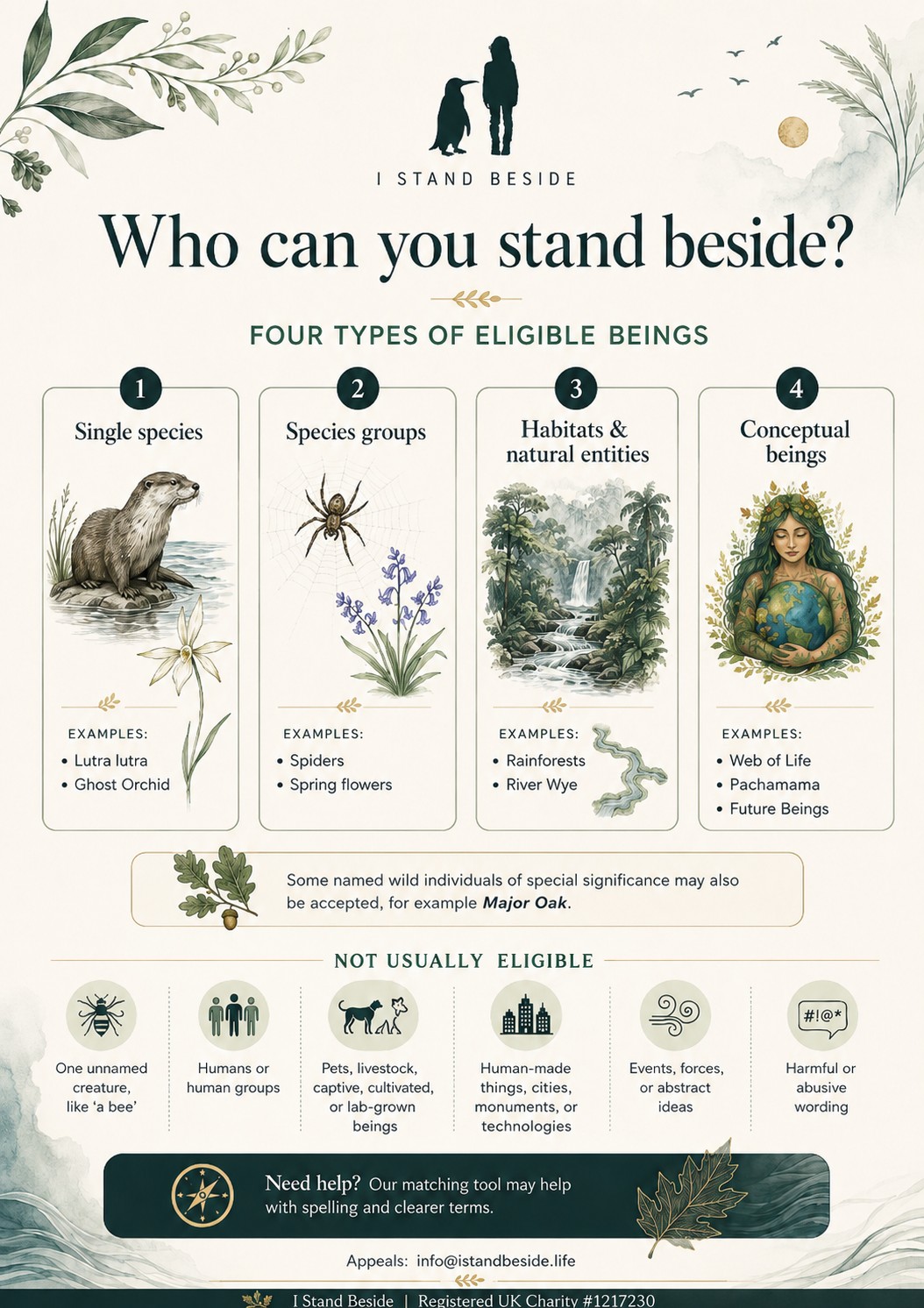
As I Stand Beside grows, we are learning how important it is to be clear, careful and consistent about who or what people can stand beside through the platform.
At the heart of ISB is a simple invitation to form a deeper relationship with a nonhuman being, ecosystem, species group or wider living system, and to turn that relationship into learning, creative advocacy and care. To make this work well, we need transparent guidance on what counts as an eligible “Natural Entity” for ISB purposes.
We are therefore sharing our draft Natural Entity Eligibility Guidelines. These guidelines are designed to support safeguarding, clarity and fairness for members, trustees and reviewers. They help us distinguish between eligible natural entities such as species groups, ecosystems, habitats, named rivers, forests, mountains, and nature-whole concepts such as Gaia or The Earth, as well terms that fall outside ISB’s charitable purposes or safeguarding responsibilities.
The guidelines are intentionally conservative at the eligibility stage. They do not attempt to settle wider philosophical, scientific, legal, spiritual or cultural questions about what is “natural”, “living”, or a “being”. They simply define what can be selected and represented within ISB at this stage of our development.
We expect these guidelines to evolve as the platform grows, as members use it, and as trustees and reviewers encounter new edge cases. We welcome thoughtful feedback, especially from those working across ecology, safeguarding, law, Indigenous and relational knowledge systems, arts, education and community practice.
The current draft is set out below. As ever, our aim is to hold the door open to wonder, but we also need to keep the threshold clear, safe and responsible.
***
ISB Natural Entity Eligibility Guidelines
Scope
Applies to all user-submitted terms proposed as an ISB Natural Entity.
A term may be excluded under these guidelines even if it is meaningful, valid, or respected in another context.
Governs eligibility for ISB selection and participation. It does not govern all forms of speech or discussion within ISB.
How This Is Applied
At the point where a member enters or searches for a being/entity, ISB may apply these guidelines through an AI-driven prompt-based screening step.
This first-stage screening helps to:
🔤 check likely spelling issues
🧭 help disambiguate unclear or ambiguous terms
⚖️ apply the eligibility gate consistently
🌱 suggest neutral reframes where appropriate.
This AI-assisted step is part of ISB’s operational process for applying these guidelines. It does not replace trustee oversight, safeguarding responsibilities, or ISB’s right to review, refuse, or revise eligibility decisions.
Core Eligibility Principle
For ISB purposes, an eligible Natural Entity must be a coherent nonhuman living holon.
In these guidelines, “living holon” means a nonhuman entity that is one of the following:
🌿 a biota-anchored living system (ecosystem or habitat), at any scale
🦋 a biological group, taxon, or collective (typically plural or collective in wording)
🌍 a nature-whole concept referring to Earth’s living system (for example Gaia, Pachamama, Mother Earth, The Earth, The Web of Life).
ISB uses “living” in a primarily biological or ecological sense for eligibility decisions.
Animist, relational, or Indigenous ways of relating may be welcomed in ISB culture and interpretation, but do not by themselves determine eligibility under these guidelines.
Safeguarding-First Exclusion
Safeguarding takes priority in eligibility decisions.
A submitted term is not eligible where it is framed using harmful language, including (non-exhaustive):
🚫 hateful, discriminatory, or dehumanising language
🍑 sexualised, pornographic, or crudely objectifying language
🩸 violence- or cruelty-celebrating language
🫥 self-harm framing
⚔️ politically loaded human-conflict framing applied to beings (for example genocidal, ethnic cleansing, war-like or similar formulations).
Neutral ecological language may still be eligible for ordinary assessment where it otherwise fits these guidelines (for example predation, decomposition, carrion ecosystem, parasites).
What Is Eligible
A term is generally eligible if it clearly refers to a nonhuman living holon within the categories above.
This includes:
🌳 ecosystems and habitats, at any scale
🦠 nested and small-scale ecosystems, including internal ecosystems (for example microbiomes), when framed as living systems
🪵 co-produced ecological features that function as living systems or habitat (for example hedgerows, compost heaps, reed-bed systems), provided they are not primarily human-built artefacts, venues, or infrastructure
🦉 wild biological groups, taxa, and collectives, generally using plural or collective wording (for example bees, songbirds, pollinators, decomposers, guppies, fungi, extremophiles)
⛰️ generic plural ecosystem types (for example forests, mountains, rivers, caves, glaciers)
📍 named ecosystem or place-systems (for example River Wye, Wytham Woods, Mount Etna, Amazon River Basin)
🌐 nature-whole concepts naming Earth’s living system (for example Gaia, Pachamama, Mother Earth, The Earth, The Web of Life).
What Is Not Eligible
A term is not eligible if it refers to:
🐝 a single individual organism, whether generic or named
🏔️ an unnamed single instance of an ecosystem-type (for example “a forest,” “a mountain,” “a river”)
👥 a human individual or human collective, organisation, brand, state, or economy
🐕 a domesticated, pet, captive, cultivated, lab-grown, or lab-cultured living thing as the selected referent
🏙️ a human-built artefact, venue, infrastructure, or system as the primary referent (for example cities, monuments, AI systems, internet systems, machines, attractions), even where living organisms are present within or around it
🔥 an event, process, force, or abstract concept rather than a living holon (for example wildfire, erosion, pollination, gravity, justice)
🧙 a fictional being, deity, or spirit framing, unless it is clearly used as a nature-whole concept (as above).
Humans may of course be part of wider ecosystems, but these guidelines concern selectable referents for ISB purposes.
Ambiguous Cases and Appeals
Where a term is too vague, unclear, or ambiguous to determine eligibility, ISB may decline it or request a clearer reframe.
Users are encouraged to reframe ambiguous terms as:
🦋 a biological group or taxon
🌲 a plural ecosystem type
📍 a named ecosystem or place-system
🌍 a nature-whole concept.
If a user disagrees with an eligibility decision, they may submit a short appeal with reasons to info@istandbeside.life.
ISB will review appeals in line with these guidelines, safeguarding duties, charitable purposes, and trustee oversight.
Interpretation Principles
Theese guidelines should be interpreted in line with ISB’s safeguarding duties, charitable objects, and values.
Where a term could be interpreted in more than one way, ISB should prefer the safest interpretation consistent with this policy.
Where no clear eligible reading is available, the term should be treated as not eligible or referred for review.
These guidelines are intentionally conservative at the eligibility stage. Cultural, poetic, relational, and interpretive depth may be explored later once an eligible referent has been selected.
Governance and Review
These guidelines are owned by ISB and maintained by the author or delegated policy lead, with trustee oversight.
Material changes to safeguarding thresholds, inclusion categories, or exclusion categories should be approved by trustees.
These guidelines should be reviewed at least annually, or sooner if safeguarding incidents, legal or regulatory changes, or major changes in ISB’s scope or services indicate a need.