Alan FraserAlpine Blue Sow Thistle
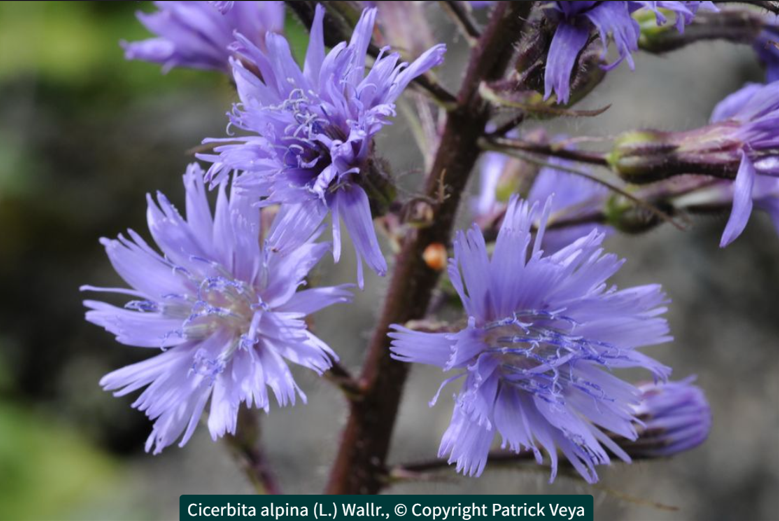
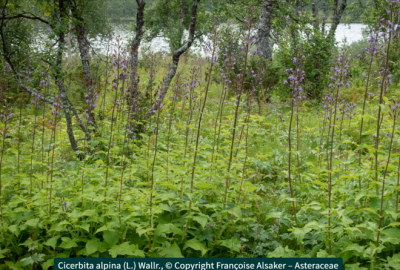
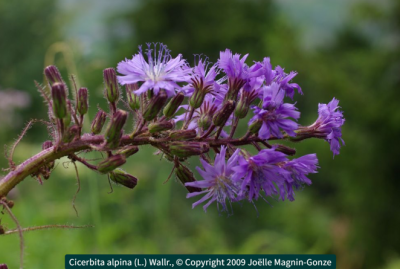
Nobody I know has ever heard of the native Scottish flower, the alpine sow-thistle (Cicerbata alpina). It is not even mentioned in my copies of Collins Guide to Scottish Wild Flowers or The Oxford Book of Wild Flowers. In a classic example of “shifting baseline syndrome”, we have forgotten that it was ever here and so don’t notice its absence. Yet this statuesque plant, growing up to 1.5m tall and with lilac-blue flowers 2.5cm across, is still fairly common in the Alps and in Norway on similar latitude to northern Scotland. Here in Scotland a decade ago it was confined to just 4 rocky inaccessible mountain ledges in the Cairngorms but in Norway it grows happily in hill meadows and damp woodland. Why is a plant common enough on one side of the North Sea virtually extinct on the other side and the few remaining flowers growing in quite different habitats?
The tale of the alpine sow thistle illustrates our dysfunctional management of the land in Scotland but the solution to its near demise show us the way forwards to a new relationship with nature.
The alpine sow thistle was once much less rare in Scotland and behaved like it does in Norway, growing along streams and wooded valley floors. However, stocking the highlands with sheep and then unnaturally high deer numbers for bloodsports led to the plant becoming virtually extinct. It was confined to a few genetically inbred specimens on high mountain ledges inaccessible to grazing animals, where the harsh conditions further inhibited ability to reproduce. The same artificially high grazing pressures have led to the effective extinction of our montane scrub and to our remaining areas of native forest slowly dying due to lack of natural regeneration.
However, the saving of the alpine sow thistle demonstrates how we can save the wider highland landscape & restore our ecosystems. Work by the Royal Botanic Garden of Edinburgh to propagate existing plants, grow them on in safe controlled sites and cross-pollinating to create new more genetically diverse plants means that there is now a healthy population to return to the wild. This is a plant highly npalatable to everything from deer to slugs, so it needs to grow at high density in large patches so that predators cannot overwhelm it. Planted at this extent in places where deer have been reduced in numbers to a more natural level it thrives in the same meadows & woodlands here in Scotland as it does over in Norway.
In our degraded land, sometimes nature needs help from us to recover but once that recovery is underway and we keep grazing pressure to a natural level, regeneration of lost ecosystems can be spectacular.
Let’s learn from the alpine sow thistle!